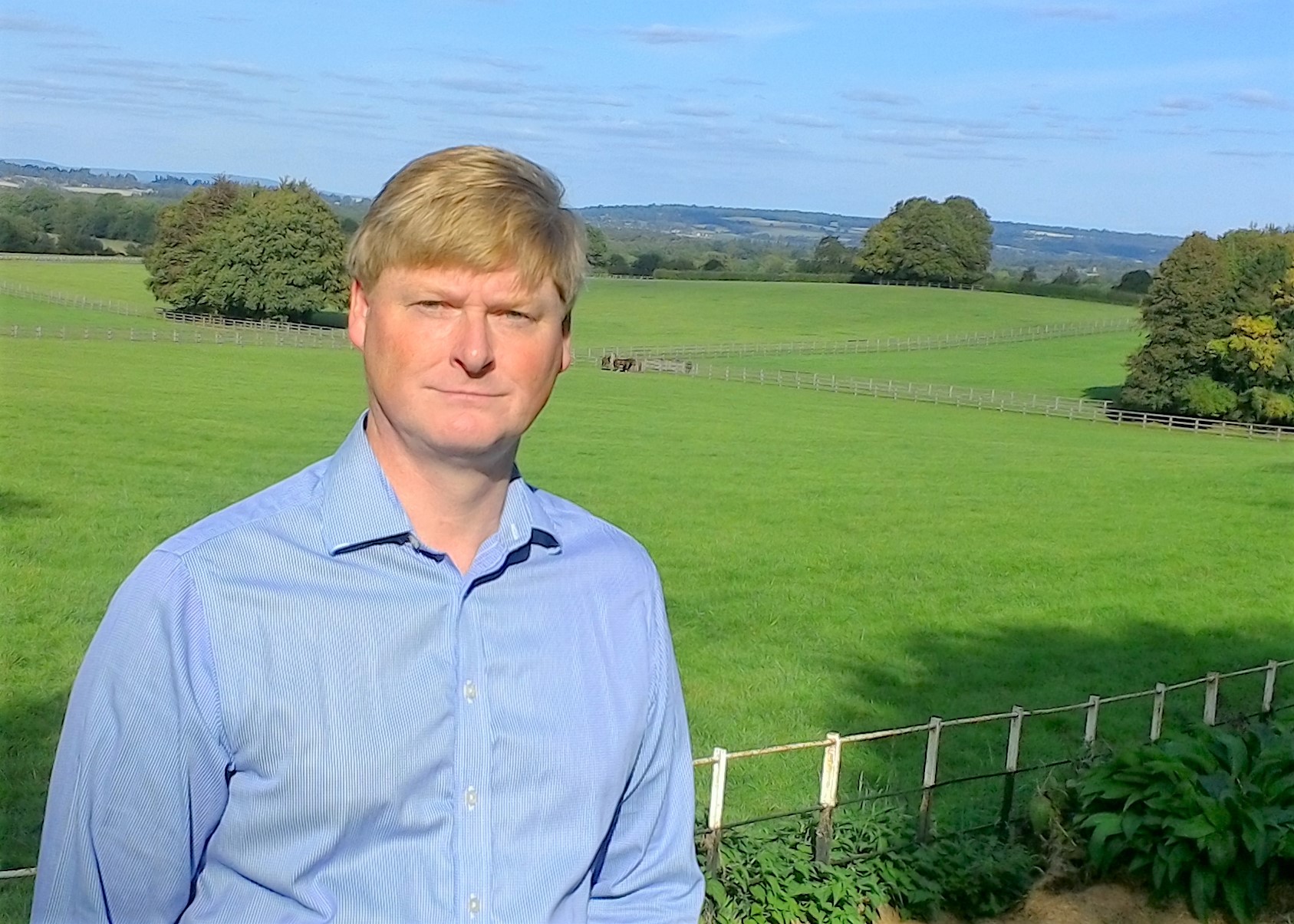
Hi, my name is Simon Mitchell, and I'm a maths tutor.
Ah, a gap year student!I'm a qualified teacher, professional tutor, and former strategy consultant. My gap year was quite some time ago: MSc (Econ) Birkbeck, London; BSc (Maths & Stats) St Andrews.
Alright, so you're not wet behind the ears. Where are you based?I live in Graffham, West Sussex. I tutor face-to-face in Midhurst, Haslemere, Petworth, Pulborough, Arundel, Chichester, Emsworth, Petersfield, and surrounding villages.
What about online?I tutor students online in Shanghai, Seville, and Salisbury ... Steep, Selham, and Storrington ... and at school at Sherborne, Shrewsbury, and Seaford.
Aha! Awesome alliteration always appeals. But are you any good?Most of my work comes from word-of-mouth recommendation. However, the success of all my tutees is entirely due to their effort. I only guide and encourage.
Very modest. So, who are these tutees?Each pupil is different. Some are focused on exams or selective-school admission; others I have supported from 8 to 18. Some lack confidence and appreciate the lack of peer pressure; others are extremely confident and want to be stretched further.
Ok, I'm intrigued. My youngest has her Pre-Tests next academic year, when would be the best time to engage a tutor?Students preparing for exams benefit from support over at least six months, ideally the full two-year syllabus. Confidence developed in tutorials symbiotically enhances engagement in the classroom.
So, start early this academic year. How long is each tutorial?Tutorials last 60 minutes for younger students. Most GCSE students benefit from 90-minute sessions. A level tutorials are two hours face-to-face and 90-minutes online. Without a looming assessment, tutorials are usually weekly.
Understood. Now, how much do you charge?My fee is £65 per hour (rising to £80 for A level and IB), invoiced monthly, and payable by bank transfer. Full terms and conditions.
Alright, let's talk some more.Email me (simon.mitchell@escry.com) or WhatsApp me (07850 125519). Together, we'll tailor the right programme to help your child succeed.
Get in touch today →Photograph of Simon Mitchell
The towns and villages to which I travel
Face-to-face tutorials make it easier to build a strong rapport from the outset. With younger pupils, hands-on learning with value counters, protractors and compasses is also more natural.
I am always happy to schedule face-to-face tutorials - without restriction or additional cost - within 15 minutes' travel of Graffham. That includes Cocking, Bepton, Heyshott, Hoyle, Amberham, East Lavington, Midhurst, Easebourne, Lodsworth, Selham, River, Tillington, Upperton, Petworth, Byworth, Duncton, West Lavington, and of course, Graffham - the towns and villages within the smaller crimson ellipse on the map below.
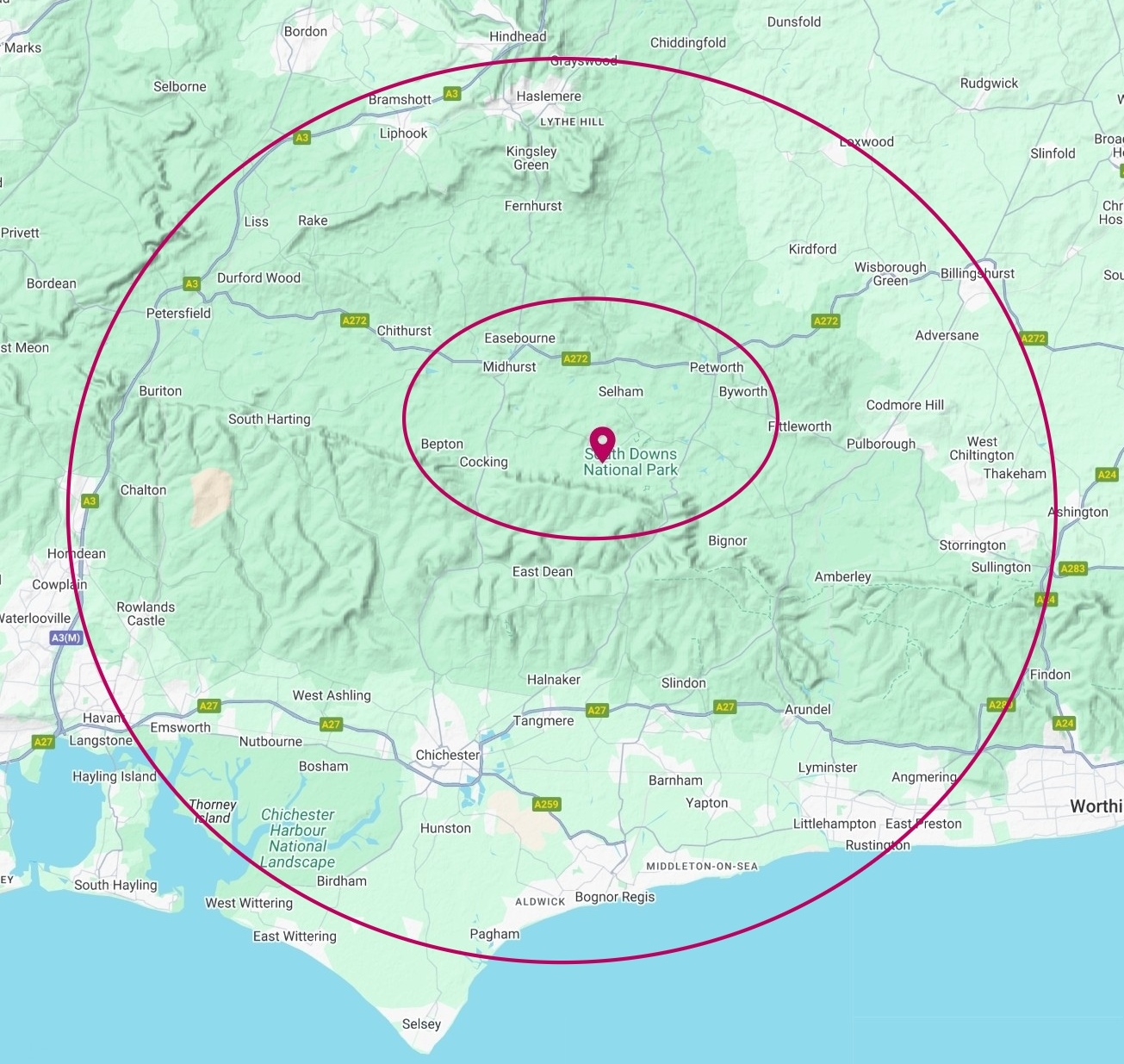
I also travel further afield: to Petersfield, Haslemere, Billingshurst, Pulborough, West Chiltington, Storrington, Arundel, Chichester, Emsworth, Fittleworth, Bignor, East Dean, Chithurst, ... indeed, throughout the area between the two crimson ellipses.
The minimum chargeable duration for these home visits is 2 hours.
A flexible mix of face-to-face and online
Most tutees use a mixture of face-to-face and online tutorials, with the balance changing through the school year.
Face-to-face tutorials are particularly valuable for building rapport and working together naturally. Online tutorials provide greater scheduling flexibility, particularly during the school day and periods of intensive study.
Finding the right balance
New tutees
I have beamed into family kitchens in Shanghai, Nairobi, Madrid, Edinburgh, and London for a WhatsApp introduction, then delivered every tutorial online. Some tutees live overseas; others board in Britain and return home during the holidays.
For families in West Sussex, however, I generally prefer the first few tutorials to be face-to-face. This helps establish a strong rapport from the outset. Thereafter, we can use whatever mix of face-to-face and online tutorials works best.
Term-time
During term-time, A level students and many GCSE students have gaps in their school day suitable for regular online tutorials. Gaps which might otherwise - erroneously - be called "free periods", fulfil their proper function as "study periods".
Otherwise, a regular evening or weekend tutorial, either face-to-face or online, maintains momentum and keeps me closely engaged with your child's progress.
Christmas, Easter, and half-terms
Christmas, Easter and half-terms are busy, particularly as external assessments approach. Tutees often schedule several tutorials each week.
Online tutorials make shorter, more frequent sessions particularly easy to schedule; face-to-face tutorials remain an excellent option where time and geography allow.
Summer holidays
Parents of tutees approaching their GCSE or A level year often schedule a programme of five to ten two-hour tutorials over the summer. If you are spending the summer in a town or village to which I travel, then face-to-face tutorials are an excellent choice.
Some kind words from clients and tutees
Good morning Simon ... Just to let you know I have given your number to some family friends of ours who have a son ... in desparate need of a good maths coach and I thought of you!!! Olivia
I cannot thank you enough for all your help. I mean it when I say you are the best teacher I’ve ever had for any subject. Callum
Hi Simon, Paper 3 tomorrow. Ahead of it, I just wanted to say thank you for all your help, I really appreciate it. I suppose that marks the end of our tutorials - it's somewhat upsetting! Theo
Many thanks for all your hard work, expertise teaching and all the many hours you put in with Jean. He enjoyed and was priviledged to have you as his tutor ... would you do tutoring for our youngest son too? Marie-Louise
I can heartily recommend Simon Mitchell for maths tuition. Less than one month before my son's AS level maths exam ... he was predicted to get a D grade ... Very quickly Simon arranged for my son to have a number of lessons and amazingly brought him up to a B grade within a couple of weeks. Simon continued to tutor through year 13, always preparing ahead for sessions ... He is extremely patient and encouraging. My son surprised us all (including himself) by getting an A* at A level. Ginny
Dear Simon, Thank you so much for your tuition and guidance over quite a few years! It will fell strange not seeing you each Wednesday! Very best wishes and a huge thank you. Madison and Baileigh
Pedagogy of a maths tutor in 1000 words
Each pupil is different – true, but not enormously insightful. Physicists, economists, architects, and chefs all create simplified models to explain, predict, and inform policy or procedure. Educators are no different – we select from a myriad of tools and techniques, informed by simplified models.
Bloom's taxonomy
Bloom’s taxonomy describes learning as progressing through a hierarchy of cognitive attainment. First, we remember newly encountered knowledge.
we can state the double angle identity for sineThen, we understand – we grasp the meaning behind our learning.
we can explain how the graph of sine is symmetric about the origin, referencing standard trigonometric propertiesThen, we apply our knowledge in straightforward situations until we attain confidence.
we can solve 3 sin(θ) = 1, for θ in the interval 0 ≤ θ ≤ 2πThese lower-order skills underpin higher-order learning.
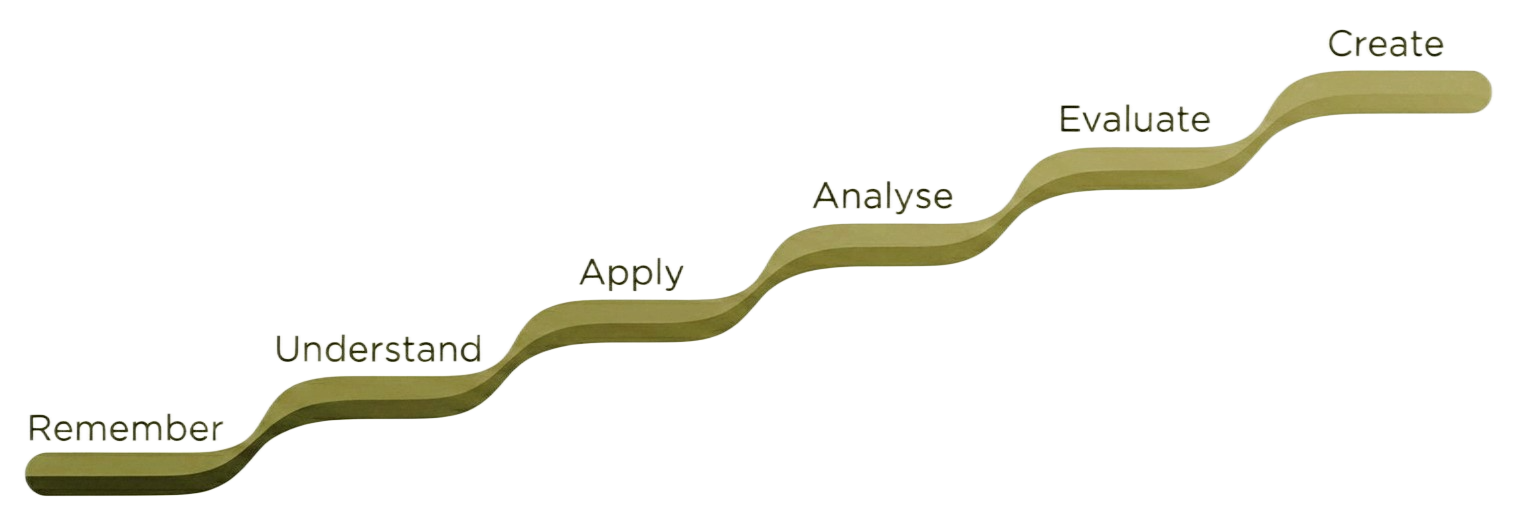
We analyse – we break down structure, identify patterns, and contrast methods.
to simplify sin(x) / {1 − cos(x)} we compare two methods: multiply top and bottom by {1 + cos(x)}; versus substitute cos(x) = 1 − 2 sin²(x/2), to find which is more efficientNext, we evaluate: not just the skill, but also how new learning connects with existing understanding; and how impactful is the new learning – is it internalised as an underpinning of an existing big-picture model?
evaluate Charlie’s method: 'to solve cos(2x) = sin(x), I rewrote cos(2x) as (1 – x²)'Lastly, Bloom suggests we create original work, innovative solutions, and new internal models.
Learning styles
Felder, Kolb, Martinez, Gordon-Bull, Keirsey, Myers-Briggs, Herrmann, Honey-Mumford, McCarthy, Gregorc, and no doubt others I have yet to encounter, have all proposed pigeon-holing the population – most often into four pigeonholes – each with their own preferred learning style. There is remarkable commonality between these models, many echoing Carl Jung, the founder of analytical psychology.
At this point, the teacher can pause and apply these insights. Develop a series of ten lessons that cycle through Bloom’s taxonomy. And in each lesson, provide different approaches to learning – e.g. theoretical, practical, reflective, pragmatic [Honey-Mumford] – to appeal to the diverse learning styles within the class.
The tutor and tutee work one-to-one. Let’s finesse ...
Myers-Briggs as a Bayesian prior
Myers-Briggs provides one vocabulary. Drawing on Jung, it describes four different ways in which we may preferentially perceive information: introverted sensing (Si), extraverted sensing (Se), introverted intuition (Ni), and extraverted intuition (Ne).
I do not regard these as immutable categories; rather as a Bayesian prior: an initial expectation against which to observe a pupil. Like a bottle of Chablis: the label sets the expectation; the tasting provides the evidence.
A tailored approach to each individual tutee
Around 45% of us are introverted sensors (Si)
Favour established knowledge, accumulated experience, detail, and orderly progression. Of the four patterns described here, this most naturally follows the familiar progression through Bloom.
The rest of us beat our own path through the taxonomy.
Around 25% of us are extraverted sensors (Se)
Defined by a need for immersion, action, and immediate feedback. They live in the physical-now. The traditional Bloom path (memorising theory before applying it) feels painfully slow and disconnected from reality. They do not want to read the manual; they want to press the buttons and see what happens. Their entry point into the taxonomy is usually right in the middle.
Phase 1: Apply → Analyse
- Skip the lecture: Do not start with, “Today we are learning about gradients.”
- Start with action: Start with a physical graph, or a real-world scenario.
- Trial and error: Let them guess. Let them mess up. Se users treat errors as feedback.
Phase 2: Understand
- Introduce concept: Once they have pointed to the steepest part of the graph, then explain the concept of ‘gradient’ and how to measure it.
- Visual logic: Use diagrams, colour-coding, and spatial relationships.
Phase 3: Remember
- Repetition: Se users have low boredom thresholds. They can drill (they are often natural athletes/musicians who understand practice), but it must feel like a challenge.
- Speed runs: “See if you can solve these three questions in under two minutes.”
Around 10% of us are introverted intuits (Ni)
Cognitive style is convergent, holistic, and future-focused. They are constantly looking for the Grand Unified Theory – the single best path, or the underlying essence of a concept. Their learning is conceptual. They struggle deeply with the bottom of Bloom's taxonomy: they cannot just memorise a formula; they need to know where it fits in the maths’ universe.
Phase 1: Understand → Analyse
- Start at the end: Don’t introduce integration with the power rule. Say, “Let’s calculate the area of a shape with curved edges.”
- Provide the framework: Give them the macro view. Show them how algebra connects to geometry, which connects to calculus.
Phase 2: Evaluate → Create
- Proofs and principles: Pythagoras' theorem is conventionally illustrated with three squares. Replace them with three similar pentagons. Does the relationship still hold? Why?
- Efficiency: “We could solve it this way, but is there a faster way?”
Phase 3: Remember → Apply
- The necessary evil: Only after they respect the concept will they tolerate the tedium of practice questions.
- Reframing practice: Frame practice as calibrating intuition to ensure accuracy.
Around 20% of us are extraverted intuits (Ne)
Those with strong extraverted intuition (Ne) naturally prefer an inverted or non-linear approach. They need to see the whole complex picture first, before they care about the details – the facts or formulae. They thrive on patterns, possibilities, big-picture connections, and innovation.
Phase 1: Create → Evaluate
- Start with the puzzle: Do not start with, “Here is the formula.” Start with a complex, open-ended problem or a paradox.
- Trigger Ne exploration: “How would you measure the height of that building without a ladder?” Let them brainstorm wild ideas.
Phase 2: Understand → Analyse
- Conceptual understanding: Once hooked, explain the concept visually or metaphorically. “Calculus is the maths of infinitely zooming in.”
- Forming connections: Show them how this new topic connects to something they already know. “This is just like the geometry we did, but now in three dimensions.”
Phase 3: Apply → Remember
- The Trojan Horse: Now that they understand the concept, introduce formulae as helpful tools.
- Systematise: Help them build the structure they naturally lack.
Private tutoring fees vary widely
Hourly rates for private tutoring vary considerably, reflecting differences in experience, qualifications, subject specialism, level, location, and the service offered.
Typical hourly fee ranges · 2026
Student and graduate tutors · £20 – £35
University students and recent graduates with strong subject knowledge, but usually limited teaching or tutoring experience.
Established and experienced tutors · £35 – £55
Tutors with several years' experience, strong subject knowledge, and familiarity with the curriculum and examinations.
Professional, qualified, and specialist tutors · £50–£80
Full-time professional tutors and experienced teachers, particularly those specialising in GCSE, A Level, and IB. Fees reflect greater experience, expertise, and professional commitment.
Premium specialists and agencies · £75–£120+
Highly experienced or sought-after tutors, and premium agencies, offering specialist expertise, exceptional flexibility, or preparation for particularly demanding subjects, qualifications, and admissions.
Commitment to flexibility
Things happen. I am happy to accommodate occasional changes wherever I reasonably can.
Booking tutorials
Tutorials are agreed in writing by email or WhatsApp. Once a tutee has an established timetable, I may schedule future tutorials automatically. These will appear on your monthly invoice; please check the schedule and let me know promptly of any errors or changes. You may opt out of automatic scheduling at any time.
Rescheduling and cancellations
With at least 48 hours’ notice, occasional requests to reschedule or cancel a tutorial are normally accommodated without charge. Small changes to the start time (typically up to 30 minutes) do not count as rescheduling.
Where a pattern of frequent cancellations or rescheduling develops, I reserve the right to charge a £30 rescheduling fee for each change.
Late cancellation and no-shows
For cancellations or requests to reschedule made less than 24 hours before the tutorial, I reserve the right to charge the full session fee.
Cancellations or rescheduling within one hour of the start time, and all no-shows, will be charged in full. By this point, time will normally already have been committed to preparing for the tutorial and, for face-to-face sessions, travelling to it.
Changes requested by me
I may occasionally ask to reschedule a tutorial.
These terms and conditions are effective from 01 September 2026.