Photograph of Simon Mitchell
The towns and villages to which I travel
Face-to-face tutorials make it easier to build an early, strong rapport. And with younger pupils, hands on learning with value counters, protractors and compasses, is more natural.
I am always happy to schedule face-to-face tutorials - without restriction or additional cost - for those within a 15-minute travel-time of Graffham. That is to homes in Cocking, Bepton, Heyshott, Hoyle, Amberham, East Lavington, Midhurst, Easebourne, Lodsworth, Selham, River, Tillington, Upperton, Petworth, Byworth, Duncton, West Lavington, and of course, Graffham - the towns and villages within the smaller crimson ellipse on the map below.
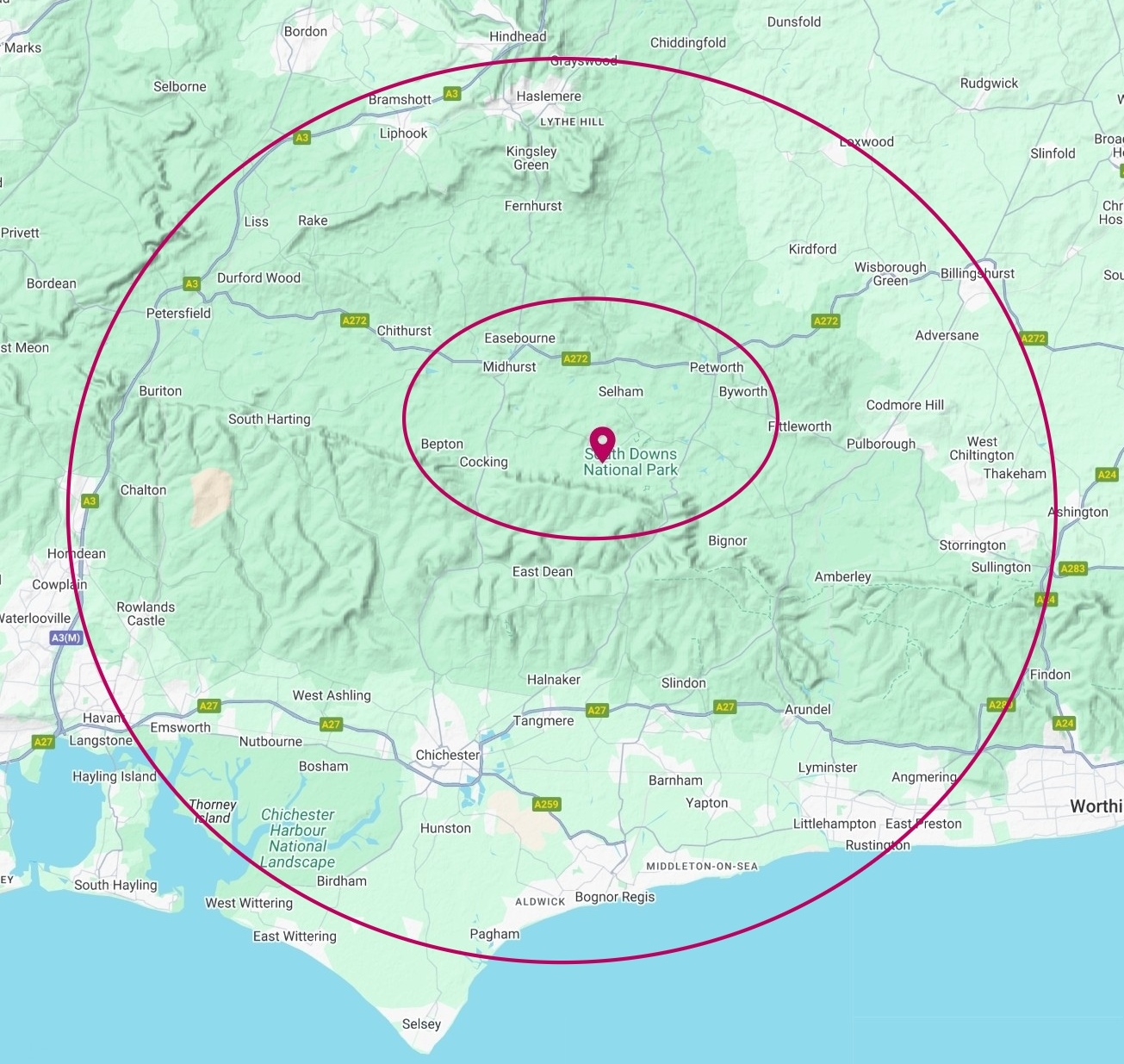
I also travel to Petersfield, Haslemere, Billingshurst, Pulborough, West Chiltington, Storrington, Arundel, Chichester, Emsworth, Fittleworth, Bignor, East Dean, Chithurst, ... indeed all the towns and villages between the two crimson ellipses drawn above.
The minimum chargeable duration for these home-visits is 2 hours.
Pedagogy of a maths tutor in 1000 words
Each pupil is different – true, but not enormously insightful. Physicists, economists, architects, and chefs all create simplified models to explain, predict, and inform policy or procedure. Educators are no different – we select from a myriad of tools and techniques, informed by simplified models.
Bloom's taxonomy
Bloom’s taxonomy of learning suggests that we learn by progressing through a hierarchy of attainment. First, we remember newly encountered knowledge.
we can state the double angle identity for sineThen, we understand – we grasp the meaning behind our learning.
we can explain how the graph of sine is symmetric about the origin, referencing standard trigonometric propertiesAnd then, we apply our knowledge in straightforward situations until we attain confidence.
we can solve 3 sin(θ) = 1, for θ in the interval 0 ≤ θ ≤ 2πThese lower-order skills, once attained, underpin progression to higher-order learning.
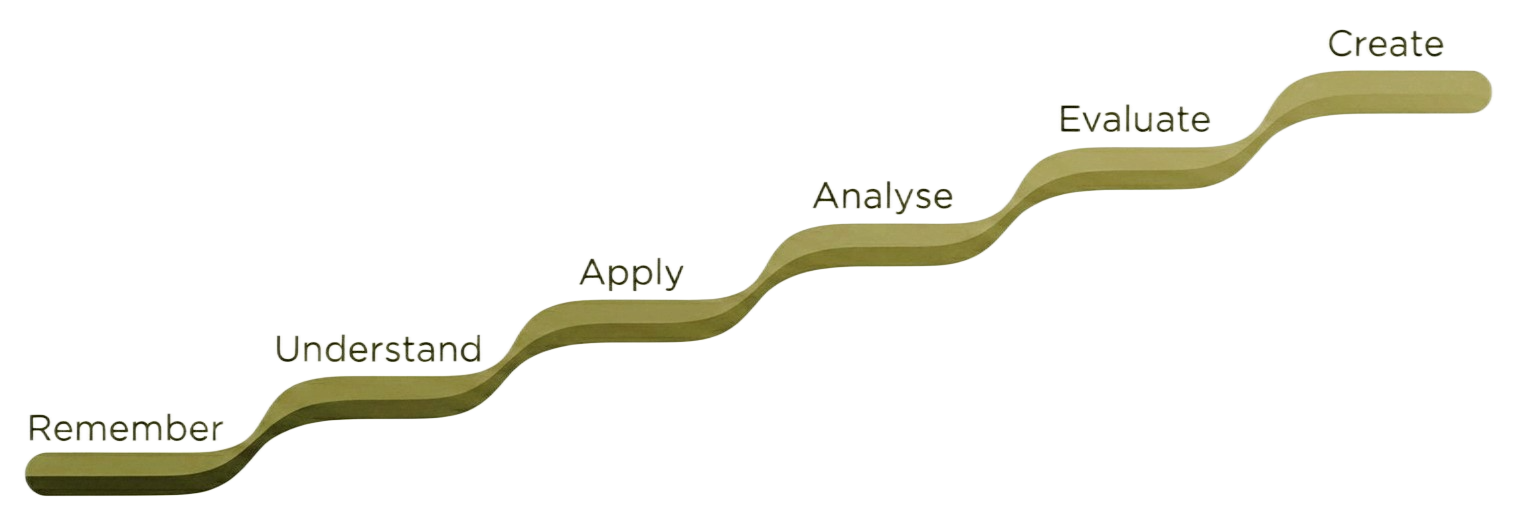
We analyse – we break-down structure, identify patterns, and contrast methods.
to simplify sin(x) / {1 − cos(x)} we compare two methods: multiply top and bottom by {1 + cos(x)}; versus substitute cos(x) = 1 − 2 sin²(x/2), to find which is more efficientNext, we evaluate: not just the skill, but also how new learning connects with existing understanding; and how impactful is the new learning – is it internalised as an under-pinning of an existing big-picture model?
evaluate Charlie’s method: 'to solve cos(2x) = sin(x), I rewrote cos(2x) as (1 – x²)'Lastly, Bloom suggests we create original work, innovative solutions, and new internal models.
53.2% have introverted sensing (Si) as first perceiving function
If this rings true for you – and perhaps sounds a little dizzying towards the end – then you, like Benjamin Samuel Bloom, are in the majority. But only just: 53.2% of the population learn along this path.
The rest of us beat our own path through the taxonomy. And so, to the concept of learning styles.
Learning styles
Fielder, Kolb, Martinez, Gordon-Bull, Keirsey, Myers-Briggs, Hermann, Honey-Mumford, McCarthy, Gregorc, and no doubt others I have yet to encounter, have all proposed pigeon-holing the population – most often into four pigeonholes – each with their own preferred learning style. There is remarkable commonality to these models, with almost all echoing Carl Jung, the founder of analytical psychology.
At this point, the teacher can pause, and apply this new learning. Develop a series of ten lessons that cycle through Bloom’s taxonomy. And in each lesson, provide different approaches to learning – e.g. theoretical, practical, reflective, pragmatic [Honey-Mumford] – to appeal to the diverse learning styles within the class.
The tutor and tutee work one-to-one. Let’s finesse ...
A tailored approach to each indivdual tutee
28.6% have extraverted sensing (Se) as first perceiving function
Defined by a need for immersion, action, and immediate feedback. They live in the physical-now. The traditional Bloom path (memorising theory before applying it) feels painfully slow and disconnected from reality. They do not want to read the manual; they want to press the buttons and see what happens. Their entry point into the taxonomy is usually right in the middle.
Phase 1: Apply → Analyse
- Skip the lecture: Do not start with, “Today we are learning about gradients.”
- Start with action: Start with a physical graph, or a real-world scenario.
- Trial and error: Let them guess. Let them mess up. Se users treat errors as feedback.
Phase 2: Understand
- Introduce concept: Once they have pointed to the steepest part of the graph, then explain the concept of ‘gradient’ and how to measure it.
- Visual logic: Use diagrams, colour-coding, and spatial relationships.
Phase 3: Remember
- Repetition: Se users have low boredom thresholds. They can drill (they are often natural athletes/musicians who understand practice), but it must feel like a challenge.
- Speed runs: “See if you can solve these three questions in under 2 minutes.”
19.0% have introverted intuition (Ni) as first perceiving function
Cognitive style is convergent, holistic, and future-focused. They are constantly looking for the Grand Unified Theory - the single best path, or the underlying essence of a concept. Their learning is conceptual. They struggle deeply with the bottom of Bloom's taxonomy: they cannot just memorise a formula; they need to know where it fits in the maths’ universe.
Phase 1: Understand → Analyse
- Start at the end: Don’t introduce integration with the power rule. Say, “Let’s calculate the area of a shape with curved edges.”
- Provide the framwork: Give them the macro view. Show them how algebra connects to geometry, which connects to calculus.
Phase 2: Evaluate → Create
- Proofs and principles: Derive the formula a² + b² = c² by evaluating the area of three similar shapes arranged with corresponding sides forming a right-angled triangle at the centre.
- Efficiency: “We could solve it this way, but is there a faster way?”
Phase 3: Remember → Apply
- The necessary evil: Only after they respect the concept will they tolerate the tedium of practice questions.
- Reframing practice: Frame practice as calibrating intuition to ensure accuracy.
7.9% have extraverted intuition (Ne) as first perceiving function
Among higher level maths and science students, these percentages flip: intuitive-types (Ne and Ni) dominate.
Those with strong extraverted intuition (Ne) naturally prefer an inverted or non-linear approach. They need to see the whole complex picture first, before they care about the details - the facts or formulae. They thrive on patterns, possibilities, big-picture connections, and innovation.
Phase 1: Create -> Evaluate
- Start with the puzzle: Do not start with, “Here is the formula.” Start with a complex, open-ended problem or a paradox.
- Trigger Ne exploration: “How would you measure the height of that building without a ladder?” Let them brainstorm wild ideas.
Phase 2: Understand -> Analyse
- Conceptual understanding: Once hooked, explain the concept visually or metaphorically. “Calculus is the maths of infinitely zooming in.”
- Forming connections: Show them how this new topic connects to something they already know. “This is just like the geometry we did, but now in three dimensions”.
Phase 3: Apply -> Remember
- The Trojan Horse: Now that they understand the concept, introduce formulae as helpful tools.
- Systematise: Help them build the structure they naturally lack.